Texts and images are both vulnerable to attack. Precisely which objects are available from the past, whose written and visual sources are saved, is astoundingly arbitrary.
— Susan Buck-Morss, The Gift of the Past
The Fran Herndon works on view at The Clock Wife (A Tale of A Tub, Rotterdam) this fall mark a rare presentation of Herndon’s works outside of the US; arriving in the context of renewed interest in her practice, following an exhibition at Et al. Gallery in San Francisco, curated by David Abel and Noah Ross. Prior to this show, the last time Herndon’s works were extensively exhibited was 2011, when the poet Kevin Killian and curator Lee Plested organized a survey exhibition of sorts at San Francisco’s Altman Siegel Gallery. Like Abel and Ross, Killian and Plested focused largely on the work Herndon produced during her close and artistically formative friendship with the poet Jack Spicer. Herndon’s beguiling work across painting, collage, lithography and illustration is now being curated and facilitated by Juf (Bea Ortega Botas and Leto Ybarra), who have become the informal custodians of Herndon’s estate. While focusing too much on the curatorial elements of this show may appear to be unnecessary, the constellation of forces that ensure Fran Herndon’s work continues to be exhibited and is able to seek new publics provides a pertinent jumping off point to situate the artist’s multidisciplinary practice. Is the fact that all three exhibitions have been mounted a deux also relevant—suggesting that the labor of making visible an incomplete archive necessitates a curatorial approach that both invokes a specific historical framework and involves a broader community beyond the immediate art world?
In the knowledge that a) there exists an audience for Herndon’s work beyond the exhibition site and b) that seeing is a form of reading, Juf has activated Herndon’s estate in a unique way, commissioning texts on her larger practice, to be published via a crucial node for contemporary west coast literature, Small Press Traffic. An exhibition as a literary form seems to me an ideal way to place Herndon, whose work was so much informed by the socio-political world of poetry (in her own time, she exhibited at the “poet’s galleries” such as The Peacock Gallery, Borregaard's Museum, and Buzz). Juf has selected a diverse range of Herndon’s paintings and collages for The Clock Wife; they range from her work in the 1960s through to more recent paintings. A focus on almost pure color, in bold brush strokes as if exposing a landscape obscured from view, appears later in life, though throughout all her work we can see a will toward abstraction and experimentation.

In an interview with writer and publisher Sezgin Boynik, the writer and critic Darko Suvin insists that Vladimir Lenin met the Dadaists in Zurich in 1916. Boynik disputes this comment; after all, no official record exists, beyond the fact that they lived in the same quarter. Suvin’s response:
We have no data they met [...] But why were they living in the same quarter? They were against the war, they were against imperialism and the whole old world, and they had to flee where they could. These two groups were what the surrealists would call ‘communicating vessels’. To refuse that kind of energy is one of the greatest mistakes of later Leninism [...] it refuses the energies available to it, it refuses present energies from workers and from intellectuals.1
When I first began researching Herndon, I was conflicted by the extent to which her name appeared determined by Jack Spicer’s. Reflexively, I was uncomfortable about the extent to which Herndon, née Godwin, born as the ninth daughter of ten children in a town in North Carolina her husband Jim described as “triple segregated,” appeared not on her own terms, but in association with other, whiter, already canonized names of the San Francisco Renaissance. I understood that Killian and others had performed a rescue mission of sorts for Spicer, whose ferociously brilliant work was in ever-wider circulation, and pleased that the type of scholarship Juf, among others, were bringing forth would allow Herndon’s work to speak on its own terms. Still, I tried to write a version of this essay that avoided the much-cited jumping off point between her and Spicer. Such an essay would be in some ways speculative: by her own account, Herndon began making art at Spicer’s urging—she began to establish herself as an artist in this context. To echo Suvin now, why refuse that kind of energy? Mapping out the social and artistic relations of the time allows us to tell history not as a sequence of discrete events determined by individual agents but as a highly collaborative, socially contingent relation in which economic and class formations were being, however successfully or unsuccessfully, contested. In an interview with Christopher Wagstaff conducted in 1985/86, Herndon describes working life on the farm in which she was born as beginning at age 4: “I see now there was a lot of unhappiness and deprivation in my parents’ lives.”2 Spicer’s principled refusal to sign the anti-Communist loyalty oath that was a condition of his employment at the University of California was one of the ways in which he blew up his chance for a bourgeois life. Needless to say, there is a type of commercial success that is contingent on sitting in rooms with power at first denied to and then refused by both Spicer and Herndon. (During a period in which she painted weekly at Robin Blaser’s house, a respite from caretaking duties rehabilitating her son Jay, Herndon recalls poet Robert Duncan telling her she could “become very famous” if she focused on painting “her” flowers. Herndon appears ambivalent: “there was something unusual about my relationship with flowers,” she says, but that would not become her orientation. Spicer impressively, emphatically refused to copyright his work. I’m reminded here of Thomas Bernhard, who before his death, banned the publication and production of his plays and novels in his home country of Austria for 70 years, enforcing copyright to subvert a state’s claim to his legacy. These are valuable artistic strategies against recuperation.3
Jim Herndon’s Everything As Expected is an account of the Herndon’s arrival in San Francisco, having met and married in Paris in the late 1950s. Upon return to California in 1957, Jim made contact with several of his friends from UC Berkeley, and Spicer was the first to come over. “It all started when Jack came by our place to watch McCarthy on the TV,” writes Herndon, immediately situating the tumult that would surface, almost be indexed, across Herndon’s collage works.4 Spicer had just finished writing After Lorca, and was already referring to his practice as “dictation,” implying that poetry came from elsewhere. As Jim recalls, “Jack slyly established a routine with Fran [...] routine is apparently an obsession with the invisible world.”5 During this period, Herndon and Spicer collaborated on the series of lithographs that would be published in his 1960 collection The Heads of the Town Up to the Aether. Herndon describes working on lithos as “a tremendous burst of energy”; like Spicer receiving dictation, Herndon describes the images as the result of “wonderful fantasy dreams.”6 In Everything As Expected, Jim writes: “She loved the litho-stone, apparently firmly connected to the invisible.” Indeed, there is something of a haunting to the works. In one etching, I’m struck by three entwined feature-less faces (a frequent motif in Herndon’s work), with perhaps a fourth, smaller figure hiding in the corner. Working with minimal gestures, the work powerfully conveys a struggle for unity.

For her second exhibition, at Borregaard's Museum, Herndon worked with collage. In the aforementioned interview with Wagstaff, she describes the genesis of these “sports collages” of 1962 in simple terms—she was working with what was available. Rosemary Mayer, in her working notes for Ghosts, lists “chance & trash” as imperative for the work. In her aforementioned interview with Wagstaff, Herndon says, “I don’t know why I decided to do collages, but Jim had a friend who was a sports enthusiast, and he got Sports Illustrated with all the wonderful color photographs, and for some reason, I wanted them.” Applying watercolor, gouache, and assemblage techniques, these works by their very materiality mold and improvise the detritus of daily life. Necessarily fragile, constructed from paper intended to be ephemeral, this series stands in contrast to Herndon’s paintings. The following lines are delivered via a cut-up method in Ghost Rides (1962), if read top-to-bottom: “CRISIS PRO,” “A QUESTION OF VIOLENCE,” “THE SPIRIT WAS WILLING,” “A collapse,” “Next Time,” “FLY,” “Revisited.”
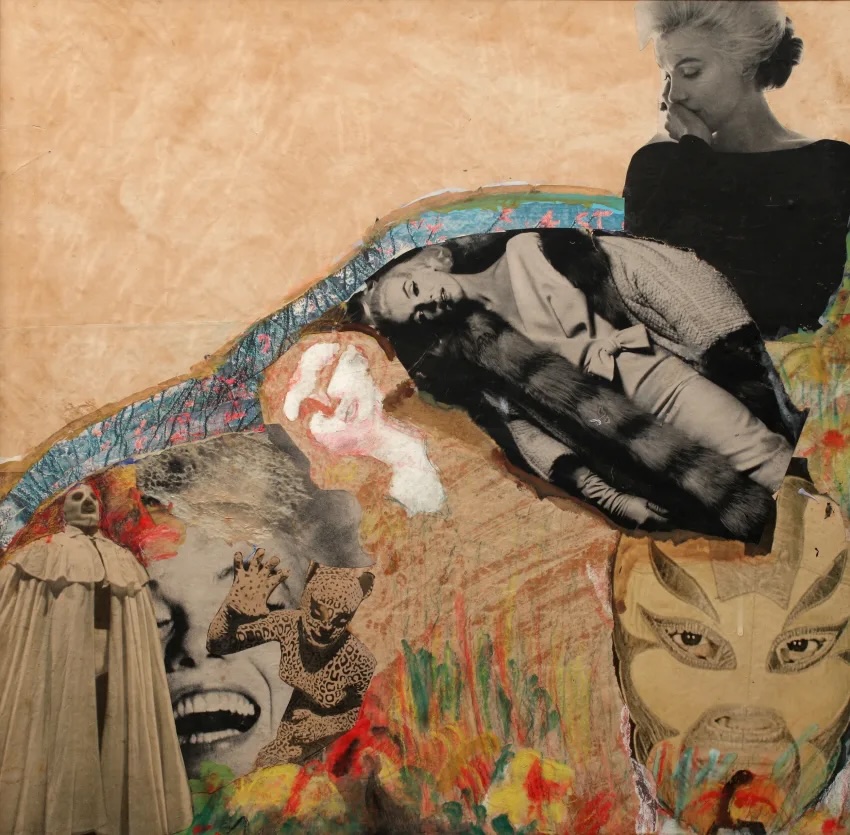
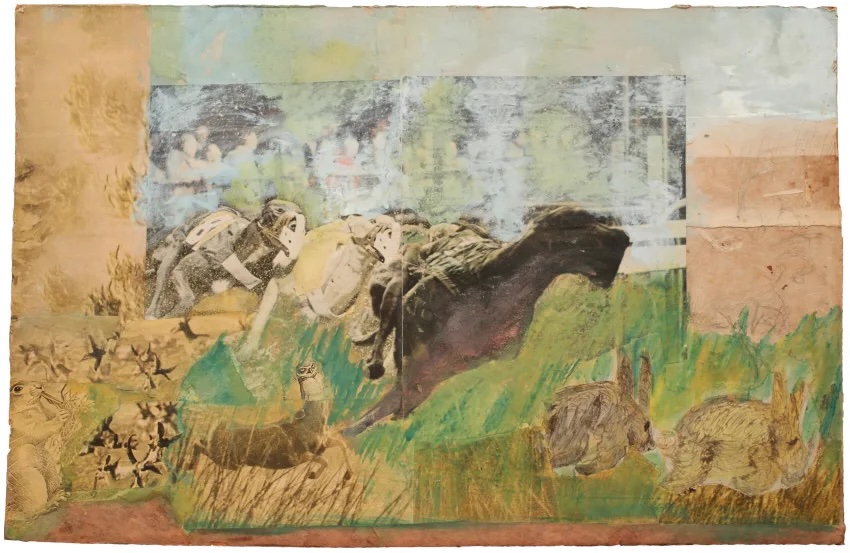
During this period, Jim Herndon and Spicer were obsessed with “the fix”—with baseball games being thrown for profit. In Herndon’s own words: “We went to baseball games ritualistically every Saturday at the baseball park, and I would make the same goddam picnic lunch and Jack would make the same comments that everybody had sold out and everything was fixed and crummy.”7 Notice the goddam in the sentence. Elsewhere Herndon is restrained about the limitations and demands placed on her. The 1962 collage Catch Me If You Can features horses in the foreground; a public with their faces effaced by a dreamlike veneer of blue and green are situated behind the animals in motion. Benjamin writes that “gambling converts time into a narcotic,” and of course “the fix” was synecdochal to the nation. In the same series, Herndon’s collage of Marilyn Monroe, titled White Angel, recalls Jacquline Rose’s analysis of the actor: “If Monroe offers an image of American perfectibility, we shouldn’t be surprised to find behind that image, as its hidden companion, a host of other images through which that same — perfectible — America indicts itself (Hollywood as a screaming white mob).”8 It was another kind of fix; in the work, there appears to be a doubling of Monroe’s face. First, the media image—tilted to imply a kind of fatigue, vertigo—then beside it, in white pencil, a face that could also be a death mask.
What does the apotheosis of success in the United States look like for an artist? The third largest employer, after Walmart and Amazon, in this country is Allied Universal—a security company. A prison in the shape of a country. I come back to Fran Herndon’s resourcefulness. I understand something of the script available to women from rural corners of her generation; I understand the extent to which she deviated from it. In a remembrance published by SFMOMA’s Open Space, her friend George Albon describes how she made it out of North Carolina:
When Fran’s teachers came out to the farm and told her father he had an exceptional daughter who should continue her education beyond high school, he was reluctant but knew they were right. She went to a two-year state college, where she was the lone minority. After college she looked for jobs. No luck: women of color were simply not going to be hired for anything other than domestic work. She told her parents she had a friend in Richmond with whom she could stay while she looked for work. Once she had their blessings, she took off — for Chicago.
She landed a secretarial position at the Chicago Analytic Institute, and was adored by the staff. But Chicago was a rude awakening. She thought racial attitudes up North must surely be better than her home counties, but Chicago turned out to be every bit as bad, its racism pervasive, big-city, systemic. Chicago was the one period of her life she didn’t like to talk about.
She applied for a job with the US Foreign Service and was sent to France, where she was very happy.”9
The difference between contingency and chance is the value ascribed to the outcome, which at the time of any event, is undetermined. Contingency tends to imply vulnerability (contingency plan, for example), while chance is an unfettered, open word. Fran Herndon, Jack Spicer and their circle show how, in a contingent world, art was made possible. A poet is a time mechanic not an embalmer.10
[1] Darko Suvin and Sezgin Boynik, “Communicating Vessels: Forms, Politics, History: Interview with Darko Suvin.” Rab-Rab: Journal for Political and Formal Inquiries in Art 2 B (2015).
[2, 3] Christopher Wagstaff, "Fran Herndon: An Art of Wonderment (An Interview by Christopher Wagstaff, 1985–1986)," (Berkeley, CA: Rose Books; Rotterdam, NL: A Tale of a Tub, 2025), 1, 13.
[4, 5] James Herndon, Everything as Expected (San Francisco, 1973), 1, 5.
[6, 7] Christopher Wagstaff, "Fran Herndon: An Art of Wonderment (An Interview by Christopher Wagstaff, 1985–1986)," (Berkeley, CA: Rose Books; Rotterdam, NL: A Tale of a Tub, 2025), 10.
[8] Jacqueline Rose, “A Rumbling of Things Unknown: Marilyn Monroe,” London Review of Books 34, no. 8 (26 April 2012).
[9] George Albon, “Fran Herndon: A Remembrance,” Open Space (San Francisco Museum of Modern Art), June 14, 2021.
[10] Jack Spicer, After Lorca, (New York: New York Review Books, 2021).
Title Image: Fran Herndon, White Angel, 1962. Reproduction courtesy of the estate of Fran Herndon; image courtesy of Kadist

Website designed and built by: Companion–Platform
a note On the Dandelion
